Tag: Latino

New Year’s Eve Traditions

Every New Year’s Eve there are certain things I do as the clock strikes midnight. There are some I do without fail and every year I add a new one that I recently discovered.

I’ve learned most of these ‘rituales’ from watching programs on both Univision and Galavision.

I know many will see these as simple superstition and nonsense, which is fine. But it is not going to stop me from doing these things. The way I see it, if you believe, anything is possible. And admittedly, some will have your friends and family looking at you as if you’ve lost your mind, but seriously, who cares?

12 uvas (12 grapes): When the clock strikes midnight, you eat one grape for each stroke of the bell. With each grape you make a wish, but be as specific as possible so you may get exactly what you wish for.

Agua (water): As the clock strikes midnight, get a glass of water and toss the water out the front door toward the street. The water symbolizes the washing away or expulsion of tears, worries and negativity from your life so you don’t carry those things into the New Year.

Red panties: After the 12 grapes, this is probably the most well-known New Year’s tradition. Trying to find red panties in Mexico on New Year’s Eve can prove to be almost next-to-impossible. The significance of the red calzones is to attract love and passion to your life in the New Year. A variation on this is tying a red ribbon around your waist under your clothing. You’ll understand this variation more when you read the next one.

Yellow panties: The significance of the yellow calzones is to attract happiness and money. Wear yellow underwear so in the New Year you will not be without felicidad y riqueza.

Maleta (suitcase): Want to make sure you will travel in the New Year? Grab your suitcase, make sure it has clothes in it, and head out the door. Walk around outside a bit. You can also dale la vuelta a la manzana. Both of these will insure you travel in the New Year.

Papel quemado (burning a piece of paper):  If you want to rid yourself of all the negative things from your past, write them down on a piece of paper. Once you have written everything down, burn the piece of paper so none of the things you wrote down will be repeated in the New Year. This can be done before midnight.

Monedas (coins): This refers to good fortune and prosperity. Hold on to 12 coins, all of which must be of the same denomination. As the New Year dawns, take all 12 and toss them toward the heavens.

Dinero (money): This one refers to your economic prosperity. Greet the New Year with a coin in your shoe or with a folded bill (the higher the denomination, the better) in your pocket.

Ropa blanca (white clothing):  It is said that wearing all white to ring in the New Year will keep away illness and bring good health.

Velas (candles): Burning candles of certain colors is said to bring distinct energies. Blue for peace; yellow for abundance; red for passion; green for health; white for clarity; and orange for intelligence.

Sit down and stand-up: If you’re looking to get married, then this one is for you. For each stroke of midnight, sit down and stand-up for a total of 12 times.

So, there you have it. These are just a few things to do to welcome the New Year. No one can guarantee that following these rituals will make all your wishes come true. But it is fun and who knows, you may be starting a new family tradition.

HAPPY NEW YEAR!!! FELIZ AÑO NUEVO!!!
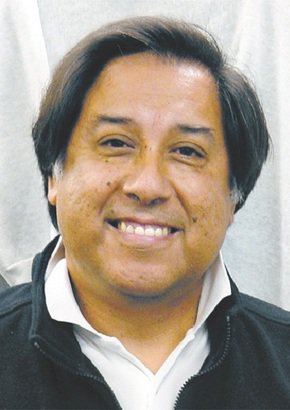


Remembering friend and journalist George Ramos

Heaven shines brighter tonight because journalism sent one of its best.

George Ramos, Pulitzer winner, professor, mentor but most of all friend.

News of George’s death this weekend shocked and saddened all of us who knew, loved and respected him.

I still find it hard to believe he is no longer with us.

I first met George at an NAHJ convention about a dozen years ago. And I last saw him in June at NAHJ’s  convention in Orlando. I ran into him at the start of the convention, as always he was volunteering his time to be a mentor for the student campus. George was a mainstay of this program, helping teach young Latino journalists how to become the best. He did this because he knew that Latinos in journalism still had a long way to go. And he was right.

The last time I spoke with him was at the airport as he waited to board his flight back to California. We spoke for several minutes about the future of NAHJ and who might be running for the organization’s presidency next year. As they called his row, I told him I would see him next year in Vegas for Unity and I wished him a safe flight home.

How could I have known then it would be the last time I would speak to him?

George was an old-school journalist in many ways. I remember at NAHJ’s convention in Puerto Rico, he was in the hotel lobby surrounded by his students, giving them final instructions for the day’s assignment. As he sent them off, we talked for a while. I asked if he was on Facebook. He scoffed and answered, “I’m a dinosaur.”

I can’t even begin to imagine an NAHJ convention without George’s presence.

His death leaves a void that cannot be filled. But I can say with all certainty that those of us who had the honor and privilege of calling George a friend, will make sure his legacy lives on.

Rest in peace, dear friend. Rest in peace.


Are we failing our students?

I’ve spent the past year-and-a-half working as an online tutor.  And I’ve seen things that make me question whether we truly believe in educating our children or if we merely want to keep them moving through the system.

I’ve encountered third-graders who cannot read. And when I say cannot read, I mean they cannot read simple words such as ‘the’ or ‘dog’ or ‘cat.’  In my mind I wondered how a student could get through to the third grade without knowing how to read.

I suppose as an outsider looking in, it is easy to cast blame. The teachers for passing the student on to the next grade so she can become someone else’s problem. Or the parent for not taking the time to make sure their child is doing their homework and studying instead of playing video games.

One thing that stood out for me is what students are being taught and at what age. Many of the students I tutored were Latino and came from homes where their parents spoke Spanish and whose own education likely ended at a very early age. As I worked through the lessons with the students, I wondered to myself how was it possible for a student to excel if they are struggling to understand the homework and have no one at home who can help them.

We constantly hear how parents need to take an active role in their child’s education. But how can this happen when the parents themselves have no idea what the PEMDAS  method is or how to dissect ‘Annabel Lee.’

But I was also amazed. When a child refused to do the work, I would call the parents. The parents, who admitted not knowing a thing about computers, would nonetheless promise to sit with their child until the session was over.  And they kept their word, I could hear them when I would speak with the student.

I question what we are teaching our children. It seems the curriculum has not evolved in the years since I left school. I wonder how do we get a child interested in reading when they cannot relate to what they are being told is required reading. When you have to explain the meaning of every other word in a story or poem that was written two centuries ago, we need to stop and ask is this really effective teaching?

Although we live in the 21st century, we are still using teaching methods from the 19th century. Today’s students live in a world where computers have always been a part of their lives and it’s time to incorporate these and other interactive methods into their learning.

To keep students engaged and make them excited about learning, then we need to use the tools of the 21st century or we risk having an entire generation who can barely read.