Category: Uncategorized

New Year’s Eve Traditions

Every New Year’s Eve there are certain things I do as the clock strikes midnight. There are some I do without fail and every year I add a new one that I recently discovered.

I’ve learned most of these ‘rituales’ from watching programs on both Univision and Galavision.

I know many will see these as simple superstition and nonsense, which is fine. But it is not going to stop me from doing these things. The way I see it, if you believe, anything is possible. And admittedly, some will have your friends and family looking at you as if you’ve lost your mind, but seriously, who cares?

12 uvas (12 grapes): When the clock strikes midnight, you eat one grape for each stroke of the bell. With each grape you make a wish, but be as specific as possible so you may get exactly what you wish for.

Agua (water): As the clock strikes midnight, get a glass of water and toss the water out the front door toward the street. The water symbolizes the washing away or expulsion of tears, worries and negativity from your life so you don’t carry those things into the New Year.

Red panties: After the 12 grapes, this is probably the most well-known New Year’s tradition. Trying to find red panties in Mexico on New Year’s Eve can prove to be almost next-to-impossible. The significance of the red calzones is to attract love and passion to your life in the New Year. A variation on this is tying a red ribbon around your waist under your clothing. You’ll understand this variation more when you read the next one.

Yellow panties: The significance of the yellow calzones is to attract happiness and money. Wear yellow underwear so in the New Year you will not be without felicidad y riqueza.

Maleta (suitcase): Want to make sure you will travel in the New Year? Grab your suitcase, make sure it has clothes in it, and head out the door. Walk around outside a bit. You can also dale la vuelta a la manzana. Both of these will insure you travel in the New Year.

Papel quemado (burning a piece of paper):  If you want to rid yourself of all the negative things from your past, write them down on a piece of paper. Once you have written everything down, burn the piece of paper so none of the things you wrote down will be repeated in the New Year. This can be done before midnight.

Monedas (coins): This refers to good fortune and prosperity. Hold on to 12 coins, all of which must be of the same denomination. As the New Year dawns, take all 12 and toss them toward the heavens.

Dinero (money): This one refers to your economic prosperity. Greet the New Year with a coin in your shoe or with a folded bill (the higher the denomination, the better) in your pocket.

Ropa blanca (white clothing):  It is said that wearing all white to ring in the New Year will keep away illness and bring good health.

Velas (candles): Burning candles of certain colors is said to bring distinct energies. Blue for peace; yellow for abundance; red for passion; green for health; white for clarity; and orange for intelligence.

Sit down and stand-up: If you’re looking to get married, then this one is for you. For each stroke of midnight, sit down and stand-up for a total of 12 times.

So, there you have it. These are just a few things to do to welcome the New Year. No one can guarantee that following these rituals will make all your wishes come true. But it is fun and who knows, you may be starting a new family tradition.

HAPPY NEW YEAR!!! FELIZ AÑO NUEVO!!!


Of figs and childhood memories

I ate a fig today, and cried.

I know it sounds crazy, but that green fig brought back memories of summers long ago; summers of a carefree youth where worries of the future seemed as far off as the sun.

My grandfather, Papa Nato, was a farmer, and he just so happened to farm figs ‑ Kadota figs to be exact. Figs don’t have a very long shelf life, so when I saw them sitting there in that plastic container at Trader Joe’s, I knew I had to buy them.

From my earliest memory figs were a part of my life. I remember how my grandfather would come home with two or three figs, the first that had ripened, and would give them to me.

I still recall peeling back the green skin to reveal the white layer and breaking the fig open to reveal the brown flesh. I remember the stickiness of that first fig and how good it was.

Yes, that fig from Trader Joe’s brought tears to my eyes, but it also brought back so many memories that made me smile.

Summer memories of a growing up in a small town; of summers spent running along the rows of figs tress with a dog named Skippy; of summer nights hearing stories told by my grandfather under the stars.

To this day I recall those stories he told of his childhood growing up in San Juan de Guadalupe, Durango, Mexico; of his boyhood adventures and then later of his trek north to work for the railroad as a young man and how he traveled the western United States with the railroad.

The tears that fig brought were not of sadness, but rather of nostalgia. Of a time when nothing mattered but that singular moment; of summers running among the fig trees, with a small black dog at my side and a grandfather who was always there.

One man’s legacy

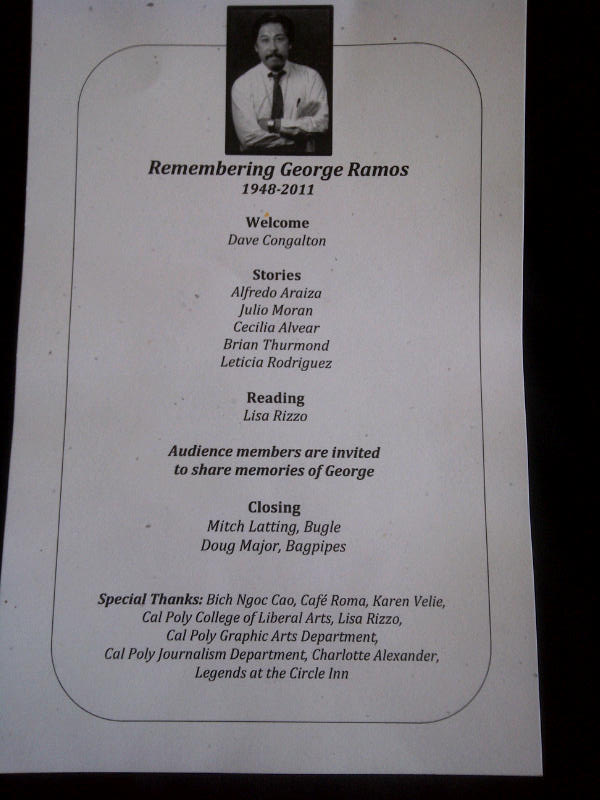
 If you can judge the impact a person had on the lives of others by the lengths they go to in order to attend a memorial service, then George Ramos had one hell of an impact.

Josie Tizcareno Pereira drove from Salt Lake City to attend. At the reception held at Legends following the memorial service, Josie explained that because of George she was able to attend her first NAHJ convention in 1997.

“So, how could I not come,” she said.

But she was not the only one who came from away. Wayne Shaw, the sports information officer during George’s time as a student at Cal Poly came from Medford. Ore. He made the journey because, as he put it while fighting back tears, it was something he had to do.

And of course there were many others who made the trip to Morro Bay to remember, honor and pay tribute to George.

There were some tears, but most of all there was laughter. 

Those of us who attended were in awe of the many things we never knew about George. Even his own brother, Dan told me he was amazed at the things he learned about George in the course of the past weeks.

I learned how George got the nickname “Mitch” but that’s a story that can best be told by Clare, the love of his life.

And we laughed when his student at Cal Poly, Leticia Rodriguez told the story of how George helped himself to her bag of Doritos. And on another occasion had her come to his “office” at Legends to review a story and then bought her a beer.

We gained a different perspective from his bartender, Les who works at Legends – which had become George’s unofficial office.

There were many facets to George, but the common thread all who attended the memorial had was that George impacted all our lives.

And as Fred Araiza said, George may be gone, but he remains forever in our hearts.


Lack of immigration reform affects many

If ever there has been one word that can bring out the worst in people it is immigration.

This is especially true when it is associated with undocumented immigrants. On Wednesday, Pulitzer winner Jose Antonio Vargas revealed in a lengthy essay that he is undocumented. He arrived in the United States as a 12-year-old from the Philippines. He’s lived the American dream, working for the Washington Post, becoming an accomplished journalist, but all the while hiding a secret.

But he is not the only one living this personal nightmare.

Last week I was in Orlando attending the NAHJ convention. I connected with a young woman I met at last year’s convention. She is bright, dedicated and has big dreams for the future. But one thing stands in her way: she too is undocumented. She is part of that growing group of young people known as DREAMers, students who would benefit from the passage of the DREAM Act.  Not only would they stand to gain so much, they would also be able to contribute and give back to the only country they know; the country they call home.

I saw her at the beginning of the convention, so full of hope, ready to show the media companies what she could offer. Two days later, I saw her again. Her demeanor had changed; she appeared demoralized. She had spoken to an immigration attorney who also was attending. He told her the news she had hoped not to hear, the chances of legalizing her status would be difficult at best and could take years.

I did what I could to offer moral support and encourage her to not give up. I stayed positive on the outside, but on the inside my heart was breaking for her. It was one of those moments when I wished I had a magic wand and could fix things.

I may not be able to change her status, but what I can do is be there for her. Offer support; let her know she is not alone. But most of all keep fighting for passage of the DREAM Act because it is the right thing to do.